
01
Closed-house conditions
Windows and outside doors stay closed for 12 hours before the test and the whole time it runs, apart from normal coming and going. The seller's side needs to know this up front.
Arizona isn't radon-free. Every county in the state sits in EPA's moderate-potential zone.
It's an unsettling thing to wonder about in a house you're about to call home, and a number beats wondering.
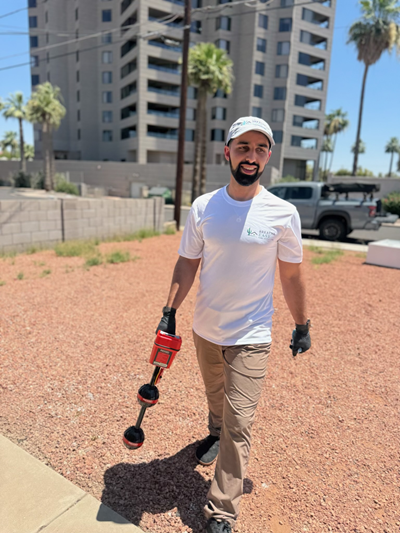
Radon is a radioactive gas that forms naturally in soil and rock and gets into homes through slab cracks, joints and openings around pipes. The EPA names it the leading cause of lung cancer among people who don't smoke. EPA's radon map puts every Arizona county, Maricopa and Pinal included, in Zone 2, moderate potential, and EPA still says the map can't tell you about a single house. Only a radon test can. Our team places and picks up the test in-house, led by Konnor Kirkwood (Arizona BTR #72416), and your report typically arrives two days after setup, such as Monday setup with Wednesday results.
Minimum test length under closed-house conditions
EPA's action level. At or above it, EPA says fix the home.
Trips on every test: one to set it, one to pick it up
Radon comes from uranium breaking down in the soil and rock under the house. The gas rises, finds the openings in your slab, and collects inside. Close the house up and it has nowhere to go. Tap a number to see where it gets in.
Any home may have a radon problem. New and old, well-sealed and drafty, with or without basements.
U.S. EPA, A Citizen's Guide to RadonA basement sits in the soil on every side, and it's the lowest lived-in level of the house. That's exactly where the test goes.
EPA also lists the water supply as a source. That mostly matters for homes on a private well.
Simple on paper. The details are what make the number worth trusting.
Windows and outside doors stay closed for 12 hours before the test and the whole time it runs, apart from normal coming and going. The seller's side needs to know this up front.
The lowest level of the home that could be used regularly, whether finished or unfinished, off the floor and away from drafts, outside doors, vents and heat.
EPA's short-term protocol for a home sale is at least 48 hours. A shorter test doesn't give you a number you can lean on.
We come back to collect the device. That second trip is part of every radon test we run.
Results come back as an average level in picocuries per liter, written pCi/L.
At 4.0 pCi/L or higher, EPA says fix the home. Between 2 and 4, EPA says consider fixing it.
If the level comes back high, we explain what a mitigation system usually involves and what to ask the seller for.
We test. We don't sell or install mitigation systems, so the number has no agenda behind it.
Typically delivered two days after setup, with the average level and what EPA recommends at that number. Monday setup normally means Wednesday results.
Results come back in picocuries per liter, written pCi/L. Each level below is EPA's estimate of lung cancer over a lifetime of breathing it.
Each grid is 1,000 people. EPA's estimates assume a lifetime of exposure at that level. A former smoker's risk falls between the two.
EPA maps all 15 Arizona counties as Zone 2, moderate potential. That includes Maricopa and Pinal. EPA also says the map can't tell you about one house. Only a test can.
Tap a county
The 1 in 15 is EPA's estimate for Arizona homes overall, the figure the state health department uses. The 26% comes from homes people chose to test, often because they had a reason to. Either way, the only number that matters is the one in the house you're buying.
We set the test device early in your inspection window and typically leave it for about 52 hours, excluding the first 4 hours to obtain at least 48 measured hours. You don't need to be there for either trip. Your report, with the average level and what it means, typically arrives two days after setup, such as Monday setup with Wednesday results.
Here's a typical week: the monitor goes in Monday morning and the results come Wednesday. You don't need to be there for either trip.
Windows and outside doors stay shut from 12 hours before the test. Normal coming and going is fine.
Lowest level that could be lived in, off the floor, away from vents, doors and heat.
We drop the first 4 hours, then record 48 measured hours. It records the whole time, including whether it got bumped.
We collect it and your report shows the average level and what EPA says to do at that number.
The usual fix is a vent pipe and a fan that pull radon from under the slab and send it out above the roof. A number during your inspection period is something you can still put in front of the seller.
Suction point under the slab. A hole through the slab gives the system a place to pull from.
A fan pulls the gas up. It keeps the space under the slab at lower pressure than the house, so gas goes into the pipe instead of your living room.
Out above the roofline. The pipe vents outside, where radon thins out into open air.
Cracks and gaps get sealed. That keeps the system working on the slab, not the room.
A licensed mitigation contractor installs it. We test; we don't install, so the number has no agenda behind it.
Test the air so you're working from lab results, not guesses.
The full walk, roof to foundation, with a report the same day.
A camera down the line so you see what you're buying underground.
Know what's coming out of the tap before you drink it.
The radon questions we hear most from buyers in the Valley. Anything else, just call.
Arizona doesn't post Midwest numbers, but EPA maps every county in the state, Maricopa and Pinal included, as Zone 2, moderate potential. EPA also says all homes should be tested regardless of zone, because the level in one specific house can only be found by testing it.
Radon forms when uranium in soil and rock breaks down. The gas moves up through the ground and gets in through slab cracks, joints and openings around pipes, then builds up inside the closed-up home.
Windows and outside doors stay closed for 12 hours before the test starts and the whole time it runs, apart from normal coming and going. Whole-house fans and evaporative coolers stay off. It keeps the result honest, so the seller's side needs to know before we set the test.
That's EPA's action level, and EPA recommends fixing the home. The usual fix is a mitigation system that pulls radon from under the slab and vents it outside. You'd negotiate it with the seller as a repair or a credit, and a licensed mitigation contractor installs it. We test; we don't install.
The test includes at least 48 measured hours under closed-house conditions. We typically leave the device for about 52 hours and exclude the first 4 hours. We make two trips: one to set it and one to pick it up. Results typically arrive two days after setup, such as Monday setup with Wednesday results.

Your Home. Your Health. Our Priority.
© 2026 Breathe Easy Home Inspections
Gilbert, Chandler, Mesa, Queen Creek, Scottsdale, Tempe, and the greater Phoenix Valley.